01 / The Compliance block
Who is the Compliance block for?
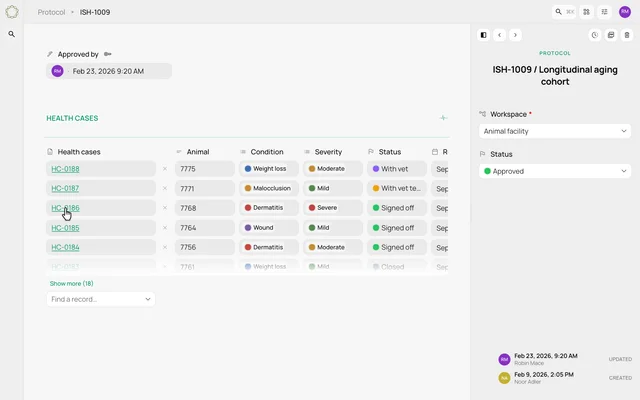
The compliance officer or IACUC administrator who owns the animal use protocol. When an inspection or a protocol review asks who did what to which animal, you want every change on the record under the right protocol, so you can answer without a scramble.
02 / The Compliance block
What comes in the Compliance block?
Six forms, one per job.
Adverse events and noncompliance
18 facilities compared, 5 ways.
Semiannual inspection findings
13 facilities compared, 6 ways.
Training and qualification
9 facilities compared, 6 ways.
Welfare concerns
8 facilities compared, 3 ways.
Hands-on competency
5 facilities compared, 5 ways.
| Form | Code | Statuses |
|---|---|---|
| Adverse event or noncompliance report | AER | Submitted → Office review → Vet and chair review → At committee → Reported out → Closed |
| PAM visit | PAM | Selected → Scheduled → Visit done → With PI → With IACUC → Closed |
| Inspection finding | IF | Recorded → Sent → Response in → Corrected → Closed |
| Training record | TR | Assigned → Current → Expiring soon → Expired → Referred to IACUC → Superseded |
| Welfare concern | WC | Received → Chair and vet review → Under investigation → Closed |
| Competency assessment | CMA | Requested → In training → Observed → Signed off → Repeat required |
03 / The Compliance block
See how the work connects
Post-approval monitoring at 13 programs, then adverse events at 18 facilities. Below, the workflows that do each handoff.
How does a PAM review reach the lab?
Programs split · 6 ways
And if a review finds a welfare problem?
Programs split · 2 ways
Straight to the vet or the IACUC
8 of 13Most common
A noncompliance or incident report
2 of 13
Not stated · 3 of 13
Does the lab answer before the IACUC sees the findings?
Programs split · 2 ways
No lab step first: the IACUC or its chair has them
9 of 13Most common
Yes: the PI or lab answers first
4 of 13
The IACUC hears the findings
Step · 13 of 13
13 of 13
Who reports an adverse event?
Facilities split · 2 ways
The PI or lab
11 of 18Most common
Anyone involved in animal care and use
5 of 18
Not stated · 2 of 18
How is the report sent?
Facilities split · 5 ways
A form sent as a file
10 of 18Most common
A web form
3 of 18
A signed paper form
2 of 18
A module in the protocol software
2 of 18
A team site
1 of 18
Who gets it first?
Facilities split · 3 ways
The IACUC office or committee
16 of 18Most common
A manager, supervisor or director
1 of 18
A vet
1 of 18
The procedure gives a vet a say in what goes further
Step · 5 of 18
5 of 18
Reported
Jules Ferreira reports an adverse event on protocol ISH-1009. It reaches the IACUC office, and Robin Mace if animals are at risk.
Reviewed
Send to vet and chair, then Send to committee. If OLAW must hear, its section opens.
Visited
A PAM visit to Noor Adler's lab ends with Send report to PI; she responds on the same record.
Corrected
The person responsible answers an inspection finding and marks it corrected. Overdue ones show each morning.
Lapsed
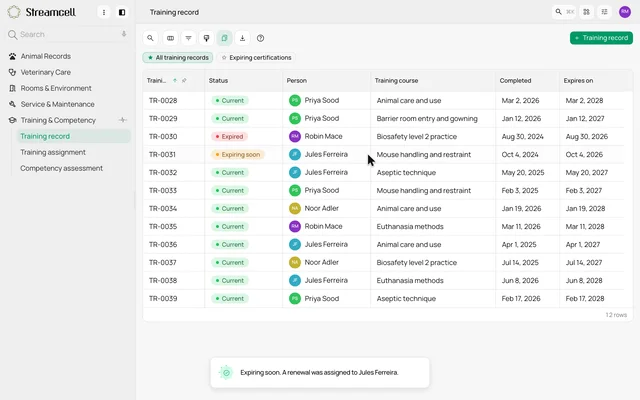
Expiring training sends a reminder; on expiry the IACUC or access office is told.
04 / The Compliance block
What will the compliance office see?
The saved views and graphs in the block.
Table
Open findings
With correct-by dates, to export for the semiannual report.
Table
Expiring in 30 days
Training about to lapse.
Table
Training by protocol
4 of 9 facilities tie training to the protocol.
Pivot
Qualification matrix
Person by course.
Morning email
Morning list
Adverse events and concerns still open.
Morning email
Visits due and responses overdue
5 of 13 set a deadline for the PI's response.
05 / The Compliance block
Make room for your way of working
It starts from the most common way; each other way is a few changes.
A booked lab visit
The default.
7 of 13Watching a procedure
Add a table of procedures watched.
2 of 13A video meeting
The meeting link goes in a field.
1 of 13Records and an interview
Add an interview table.
1 of 13Rounds on a watch list
A due date per round, on a morning list.
1 of 13Twice-yearly facility visits
One record per facility visit.
1 of 13
- Adverse events (18 facilities): a document or PDF form sent as a file at 10, a web form at 3, signed paper at 2.
- Welfare concerns (8): the IACUC's web form at 5, an animal concern hotline at 2.
06 / The Compliance block
Find your starting point
Find your starting point.
Question 1
Does the IACUC side visit labs for post-approval monitoring?
See every question
- Does the IACUC side visit labs for post-approval monitoring?
- Is an adverse event reported on a document or PDF form?
- Do inspection findings go out as a written list to answer?
- When training lapses, is there a deadline before door access ends?
- Start from the PAM visit: Like 7 of 13, the default.
- Start from the adverse event report: Like 10 of 18.
- Start from inspection findings: Like 4 of 13.
- Start from training lapses: Like 2 of 9: a notice with a deadline.
- Start from training records: Expiring in 30 days tracks expiry for you.
07 / The Compliance block
Keep what already works
- Your IACUC system. Protocols stay there; records carry the protocol number.
- Anonymous reports. 7 of 8 welfare programs offer them; they stay in your hotline or form.
- Reports to regulators leave as a PDF or an email.
- Courses stay in your learning system; the record holds the dates.
- One thing Streamcell can't do: an if-then step. Significant and minor findings run as two workflows.
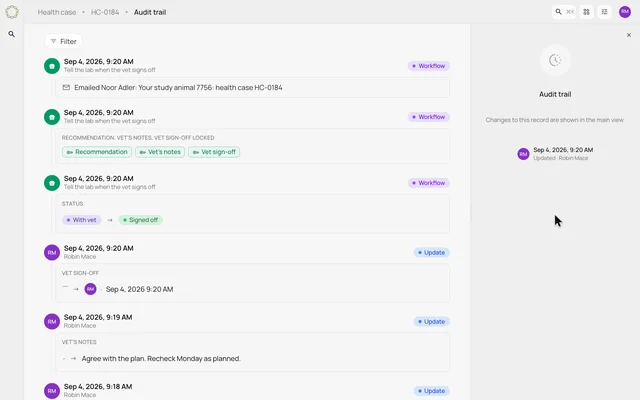
- No compliance claim. Records keep a field-level audit trail and signatures that lock fields. We don't claim they meet any standard.
08 / The Compliance block
What do buyers ask compliance software to do?
From 23 public procurement documents for animal facility software.
19of 23
ask for something in protocol, compliance, training or reports.
11of 23
ask for protocol management, which stays in your IACUC system.
8of 23
ask for regulatory reports.
4of 23
ask for electronic signatures.
3of 23
ask for an audit trail.
The block keeps the records around the protocol: signatures, the audit trail, training and findings.
09 / The Compliance block