01 / Daily room logs
What the procedures reveal
Three findings a facility manager would stop on.
8of 12
send the log or its problems first to a facility manager, supervisor or director. A vet is a receiver in 2 of 33 handoffs, both at one facility.
6of 12
state that part of the round is copied by hand into a second record, such as a census retyped into a spreadsheet.
4of 12
logs record the 24-hour high and low temperature. 7 record a temperature at all.
02 / Daily room logs
Where do facilities part ways?
One path from the round to whoever reads the log, and the four points where the 12 facilities split.
Who does the round?
Facilities split · 3 ways
Husbandry and animal care staff
4 of 12
The PI or lab
2 of 12
A designate
1 of 12
Not stated · 5 of 12
The round goes on paper at the room
Step · 10 of 12
10 of 12
How is the log kept and passed on?
Facilities split · 7 ways
A paper log at the room
4 of 12Most common
A log plus concern forms
3 of 12
Paper plus a team chat
1 of 12
Paper, then retyped
1 of 12
Paper plus electronic logs
1 of 12
One log per study
1 of 12
Scan at the cage
1 of 12
Who reads it first?
Facilities split · 3 ways
A manager, supervisor or director
8 of 12Most common
The PI or lab
3 of 12
A named contact
1 of 12
And when it's urgent?
Facilities split · 2 ways
A phone call
4 of 12
Or a text, at 1.
Direct contact, channel not named
1 of 12
Not stated · 7 of 12
03 / Daily room logs
How is the room log kept and passed on?
The second fork, way by way: where the round is recorded.
A paper log at the room
Initialed each day. Problems go by word of mouth or a call, and the sheets are reviewed or filed later.
4 of 12A log plus concern forms
A log book for the round, and a separate form, card or incident log for each concern.
3 of 12Paper plus a team chat
A check sheet for the routine; problems go to a chat channel.
1 of 12Paper, then retyped
The daily census is retyped each month into a spreadsheet for the IACUC.
1 of 12Paper plus electronic logs
Monitor readings copied onto the sheet; floods and deaths logged electronically.
1 of 12One log per study
Kept by the lab and filed with the IACUC when the study ends.
1 of 12Scan at the cage
A code on each cage; each check is scanned into a shared spreadsheet.
1 of 12
Vet staff are the first reader at none of the 12. 3 of 12 check twice on weekdays, with the morning round due by 9:30 or 10:00.
04 / Daily room logs
What should a daily room log contain?
The fields facilities' logs carry, with how many of 12 carry each one.
Daily room log
Used by, out of 12 facilities’ forms
- Draft
- Submitted
- Issue raised
- Reviewed
Room and round
- Room *Link: Housing Room4 of 12
- Round *Dropdown
Morning · Afternoon · Weekend or holiday
2 of 12 - Checked at *Date and time5 of 12
- Checked by *User8 of 12
- Species *Dropdown
Mouse · Rat · Rabbit · Guinea pig · Dog · Zebrafish · Frog · Other
3 of 12
Animals
- Animals *Dropdown
No concerns · Concern found
9 of 12 - Food OK *Checkbox6 of 12
- Water OK *Checkbox5 of 12
- Census (adults)Number3 of 12
Room conditions
- Temperature now *Number6 of 12
- High, last 24 hNumber4 of 12
- Low, last 24 hNumber4 of 12
- Humidity nowNumber4 of 12
Tasks done
- TasksChecklist4 of 12
Feed
- Feed use-by dateDatefor the workflow
Aquatic checks opens when the workflow reaches it
- Water clearCheckboxfor the workflow
- Tank and filter workingCheckboxfor the workflow
- Water changedCheckboxfor the workflow
- pHNumberfor the workflow
- Ammonia / nitriteNumberfor the workflow
Issue opens when the workflow reaches it
- What kind *Dropdown
Temperature or humidity · Water supply · Lighting · Leak or flood · Rack or equipment · Pests · Other
for the workflow - What's wrong *Rich text1 of 12
- Who was toldUserfor the workflow
Comments and sign-off
- CommentsRich text5 of 12
- Signed *Signature8 of 12
9 of 12 record a health check of the animals, 8 who did the round and 6 the food. 1 adds water checks for its fish and frog rooms. Some logs copy each other: two share the same 17 columns.
05 / Daily room logs
Find your starting point
Answer yes or no to find the facilities that work the way yours does.
Question 1
Does anything from the round go into a computer: a spreadsheet, a chat channel, an app or an electronic log?
See every question
- Does anything from the round go into a computer: a spreadsheet, a chat channel, an app or an electronic log?
- Do the routine checks go on the computer, not only the problems?
- Do you scan a code on each cage to record the check?
- Do you post problems in a team chat channel?
- Does a lab keep the log for one study and hand it to the IACUC at the end?
- Does a problem found on the round go onto a separate form, card or log?
- A paper log at the room: You work like 4 of the 12 facilities we read, the most common way. Each round is a record, and the month shows as a calendar.
- A log plus concern forms: You work like 3 of the 12. A concern emails the vet team from the round itself.
- Paper plus a team chat: You work like 1 of the 12. Issues post to Slack or Google Chat.
- Paper, then retyped: You work like 1 of the 12. The census is a field on each round, exported each month.
- Paper plus electronic logs: You work like 1 of the 12. Floods and deaths become records linked to the room.
- One log per study: You work like 1 of the 12. Filing it emails the IACUC office the record's PDF.
- Scan at the cage: You work like 1 of the 12. Staff open the room's record instead.
06 / Daily room logs
What do the rules ask for?
A daily look at every animal. None sets the log's form or how long it is kept.
- Animal Welfare Act regulations: every covered animal observed daily, with problems reaching the attending vet (9 CFR 2.33). They do not cover purpose-bred mice and rats.
- The Guide, as guidance: animals observed at least daily, weekends and holidays included; rooms at 20 to 26 °C for mice and rats; humidity of 30% to 70% for most mammals.
- CCAC guidelines (Canada): daily observations recorded and initialed, with the time, even when nothing is wrong.
07 / Daily room logs
How does Streamcell run it?
The default is the paper log at the room: one record per room per round.
Round
Priya Sood ticks food and water and logs 22 °C and 45% humidity. Submitting locks the signed fields.
Concern
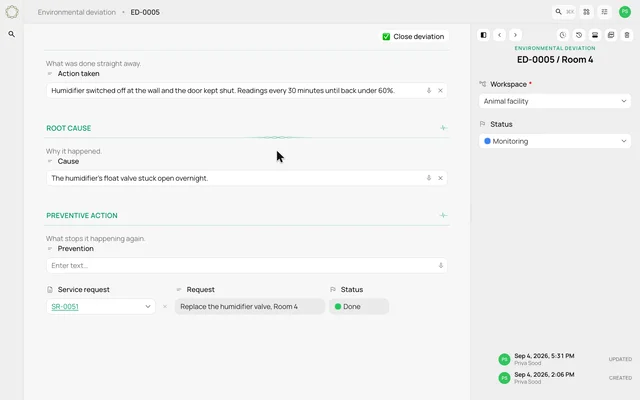
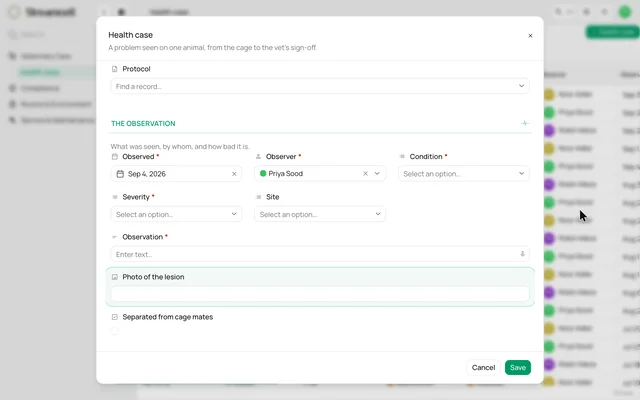
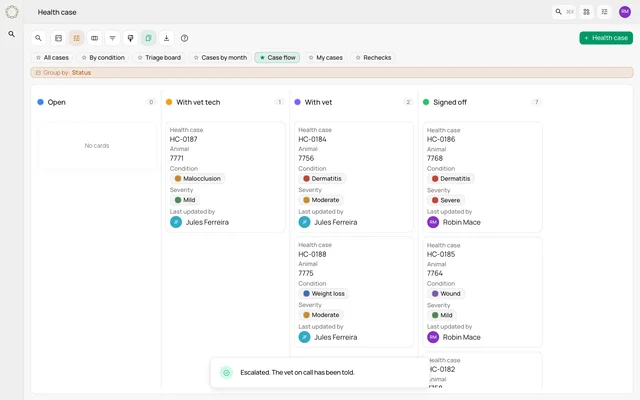
She sees a skin lesion on 7756 and sets Animals to Concern found. Jules Ferreira is emailed and opens HC-0184.
Out of range
A reading outside the room's range emails the manager, and the round shows Issue raised.
Reviewed
The manager presses Mark reviewed. At 10:00, a morning round still in draft emails whoever started it and the manager.
Each room type gets its own range workflow, because Streamcell has no if-then step. Facilities that want paper on the door keep it.
08 / Daily room logs
The research behind this guide
We read the public procedures of 12 research animal facilities in the US and Canada, all universities, in October 2026. Counts are facilities, not documents.