01 / Health cases
What the procedures reveal
Three findings a vet or facility manager would stop on.
13of 16
name a step that tells the PI or lab about the case, 8 of them by email. None keeps it for animals whose study is affected.
5of 16
give the lab a deadline to answer. At 4 of them the vet staff act when it runs out.
2of 14
case records have a place to note that the lab was told.
02 / Health cases
Where do facilities part ways?
One path from the card on the cage to the lab, and the four points where the 16 facilities split.
The case starts from a card on the cage
Step · 11 of 16
11 of 16
Who takes the case?
Facilities split · 6 ways
Vet staff or a vet tech
8 of 16Most common
Husbandry and animal care staff
2 of 16
A designate or technician
2 of 16
A manager or supervisor
1 of 16
A vet
1 of 16
The PI or lab
1 of 16
Not stated · 1 of 16
Where is the case kept?
Facilities split · 6 ways
A paper case file
6 of 16Most common
Software plus a card on the cage
3 of 16
A line in a facility log
3 of 16
A vet module in software
2 of 16
The card is the record
1 of 16
One web form per case
1 of 16
Who has it next?
Facilities split · 2 ways
The PI or lab
12 of 16Most common
A vet
3 of 16
Not stated · 1 of 16
How does the lab hear?
Facilities split · 2 ways
By email
8 of 16Most common
Channel not named
5 of 16
Not stated · 3 of 16
03 / Health cases
How is a health case run and recorded?
The second fork, way by way: where the case is kept.
A paper case file
Each case or animal gets its own sheet, most often matched to the cage card by a case number, and kept in the room or a binder.
6 of 16Software plus a card on the cage
The case is opened in software, and a card on the cage is part of the record: at 2, a treatment card initialed for each dose.
3 of 16A line in a facility log
The case is a line in an incident, treatment or room log, plus a card or tag.
3 of 16A vet module in software
The case, its plan and its checks live in a vet module in software.
2 of 16The card is the record
Assessments and treatments are written on the sick card.
1 of 16One web form per case
The vet reports each case to the attending vet: problem, diagnosis, treatment.
1 of 16
8 of 16 state that the case is written in two or more places, such as software plus the treatment card. Who gives the treatment differs: the lab at 1, the vet team at 2, either by arrangement at 6, a role set on a dashboard at 1, and 6 don't say.
04 / Health cases
What should a health case record contain?
The fields facilities' case records carry, with how many of 14 carry each one.
Health case
Used by, out of 14 facilities’ forms
- Open
- Waiting on lab
- Under treatment
- Monitoring
- Closed
The case
- AnimalLink: SoftMouse animal9 of 14
- Cage *Link: SoftMouse cage4 of 14
- Species *Dropdown
Mouse · Rat · Zebrafish · Rabbit · Guinea pig · Other
5 of 14 - Protocol *Text7 of 14
- PI *User8 of 14
- Lab contactUser2 of 14
- From reportLink: Sick animal reportfor the workflow
- First seen *Date5 of 14
- Signs *Dropdown4 of 14
- What's wrong *Rich text6 of 14
Vet assessment opens when the workflow reaches it
- Severity *Dropdown
Urgent, critical · Serious, not urgent · Stable, treat · Stable, monitor
2 of 14 - DiagnosisText5 of 14
- Plan *Rich text8 of 14
- Vet sign-off *Signature1 of 14
The lab opens when the workflow reaches it
- Lab told at *Date and time2 of 14
- Lab must act byDatefor the workflow
- Lab's decisionDropdown
Treat as advised · Euthanize · Agree another course
for the workflow - Who treats *Dropdown
Vet team · Husbandry staff · Lab
1 of 14
Checks and treatments opens when the workflow reaches it
- LogTable10 of 14
- Next recheckDate2 of 14
Closure opens when the workflow reaches it
- Outcome *Dropdown
Resolved · Chronic, monitor only · Euthanized · Euthanized at study endpoint · Died
5 of 14 - Closing summaryRich textfor the workflow
10 of 14 keep a dated, initialed log of checks or treatments, 9 the animal and 8 each the PI and the plan.
05 / Health cases
Find your starting point
Answer yes or no to find the facilities that work the way yours does.
Question 1
Is the case kept in a computer system: software or a web form?
See every question
- Is the case kept in a computer system: software or a web form?
- Do you file one web form per case, after the fact, for the attending vet?
- Is there also a treatment card on the cage where each dose is initialed?
- Does each case or animal get its own sheet or report?
- Is the case written only on the card on the cage?
- A paper case file: You work like 6 of the 16 facilities we read, the most common way. The record number becomes the case number, with a saved view per room.
- Software plus a card on the cage: You work like 3 of the 16. The card stays on the cage, and the doses go into the record's log.
- A line in a facility log: You work like 3 of the 16. The record replaces the log line.
- A vet module in software: You work like 2 of the 16. The module stays, and Streamcell sits beside it.
- The card is the record: You work like 1 of the 16. The record becomes the medical record, and the card stays as a flag.
- One web form per case: You work like 1 of the 16. The form becomes the vet's report to the attending vet.
06 / Health cases
What do the rules ask for?
Care, records and a vet with authority. None sets the lab's deadline or says who treats.
- Animal Welfare Act regulations: appropriate methods to prevent, diagnose and treat disease and injury, emergency and weekend care, and an attending vet with authority to ensure adequate care (9 CFR 2.33).
- The Guide, as guidance: the vet and the PI decide treatment together; if the PI can't be reached or they don't agree, the vet has authority to treat, remove from study or euthanize; all treatments and outcomes are documented.
- ACLAM's public statement, a recommendation: the institution, guided by the attending vet, chooses whether the record is paper, computer or cage card.
- CCAC guidelines (Canada): medical records kept onsite, open to the vets, for at least a year.
07 / Health cases
How does Streamcell run it?
The default is software plus the card: the card stays on the cage, and the doses go into the record.
Assess
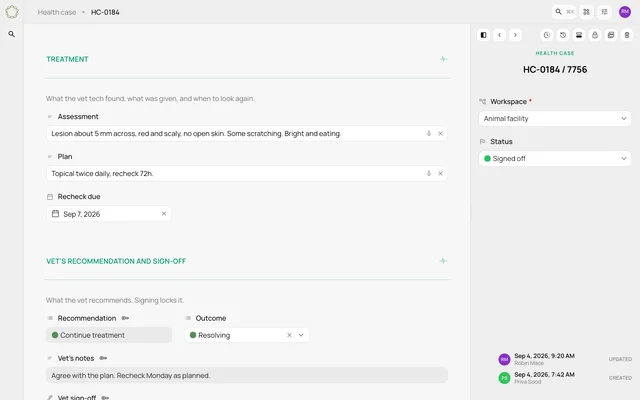
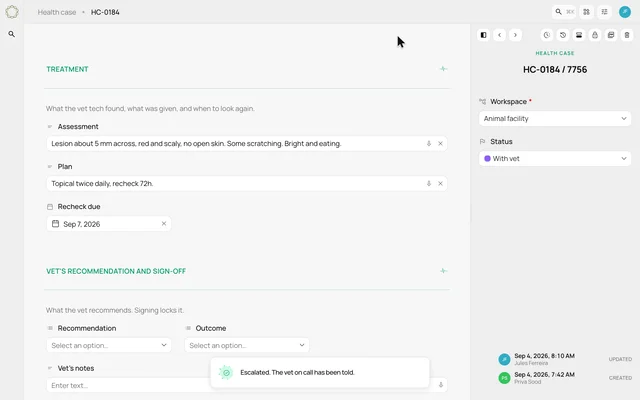
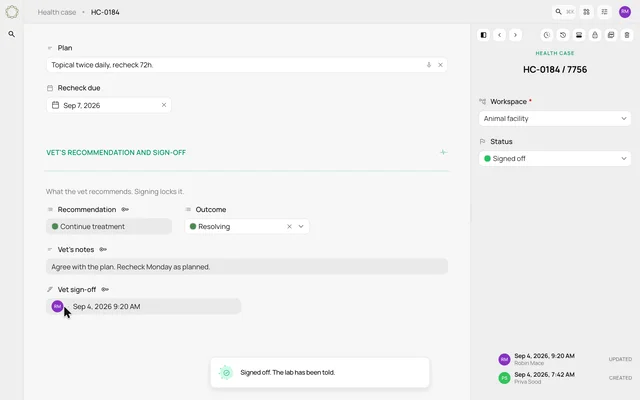
Jules Ferreira opens HC-0184 from Priya Sood's report on 7756 and records a plan. Robin Mace signs, which locks the assessment.
Tell the lab
A button emails Noor Adler, the PI on ISH-1009, and the lab contact, with the date the lab must act by.
Lab answers
Noor picks Treat as advised on the record, and the vet team is emailed. If the date comes with no answer, an 08:00 check emails the lab and the vet.
Treat and close
Each dose goes in the log. Each morning the vet techs and husbandry staff are emailed the cases under treatment. Robin closes the case as Resolved.
Tell the lab is on every case, as it is at 13 of 16 facilities. "The lab treats" and "the vet team treats" run as two workflows, because Streamcell has no if-then step.
08 / Health cases
The research behind this guide
We read the public procedures of 16 research animal facilities in the US and Canada, all universities, in October 2026, and recorded how each one runs a health case. Counts are facilities, not documents.