01 / Sick animal reports
What the procedures reveal
Three findings a vet or facility manager would stop on.
16of 20
flag the sick animal's cage with a card. 12 name its color, from yellow and pink to green, red, orange and lavender.
13of 20
say the same report is written in two or more places, such as the card and a web form.
1of 15
forms ask how urgent the case is. Urgent cases go another way at 14 of 20, most often by phone.
02 / Sick animal reports
Where do facilities part ways?
One path from the cage to the lab, and the four points where the 20 facilities split.
Who reports it?
Facilities split · 3 ways
Husbandry and animal care staff
13 of 20Most common
Anyone who sees it
4 of 20
The PI or lab
1 of 20
Not stated · 2 of 20
A card goes on the cage
Step · 16 of 20
Then Yellow, pink, green, red, orange or lavender, by facility.
16 of 20
How does the report leave the cage?
Facilities split · 7 ways
A web form
6 of 20Most common
A paper record
5 of 20
A phone call
3 of 20
A software module
2 of 20
An email
2 of 20
A scan at the cage
1 of 20
A chat channel
1 of 20
Who sees it first?
Facilities split · 3 ways
Vet staff or a vet tech
15 of 20Most common
A manager or supervisor
3 of 20
Sees it before any vet does.
A trained designate or study technician
2 of 20
And when it's urgent?
Facilities split · 3 ways
A phone call
10 of 20Most common
Direct contact, channel not named
4 of 20
The same route as any report
1 of 20
Not stated · 5 of 20
The lab is told
Step · 16 of 20
Then By vet staff, a vet tech or a vet at 12, and by a designate or study technician at 2.
16 of 20
03 / Sick animal reports
How does the report get to the vet team?
The second fork, way by way: how the report first leaves the cage.
A card plus a web form
A card goes on the cage and the report is typed into a web form or database that alerts the vet team.
6 of 20A paper record
A paper report, log or two-part card in the room. A manager or technician picks it up and decides who to call.
5 of 20Phone first
The call is the report, to a number on a sign or a contact sheet. Any paper comes after.
3 of 20A module in the facility's software
Entered in a vendor's suite, sometimes by a technician from a lab member's email.
2 of 20An email report
A templated email to a vet team list, which the facility then logs.
2 of 20Scan at the cage
Scanning the code on the cage card opens the report on a phone, and the vet team gets an email.
1 of 20A team chat channel
A card and paper notes, with the vet team told in a chat channel.
1 of 20
Whatever the route, the chain is short: two to four people, with a median of three. No facility sends a routine report straight to a named vet. Vet staff or a vet tech see it first at 15 of 20, and a manager sees it before any vet at 3.
04 / Sick animal reports
What should a sick animal report contain?
The fields facilities' forms carry, with how many of 15 carry each one.
Sick animal report
Used by, out of 15 facilities’ forms
- Reported
- With vet team
- Lab told
- Closed
What you saw
- AnimalLink: SoftMouse animal8 of 15
- CageLink: SoftMouse cage7 of 15
- Room *Link: Housing Room8 of 15
- Species *Dropdown
Mouse · Rat · Zebrafish · Rabbit · Guinea pig · Other
7 of 15 - SexDropdown
Female · Male · Unknown
5 of 15 - Date of birthDate4 of 15
- Protocol *Text8 of 15
- PI *User8 of 15
- Signs *Dropdown5 of 15
- What you saw *Rich text13 of 15
- Seen by *User7 of 15
- Seen at *Date and time7 of 15
Vet team opens when the workflow reaches it
- How the vet heard *Dropdown
This form · Phone · Email · In person · Chat
1 of 15 - Vet's advice *Rich text4 of 15
- Lab must act byDatefor the workflow
- Checks and treatmentsTable4 of 15
13 of 15 ask for a description of what was seen, and 8 each for the animal, the PI, the protocol and the room. 1 of 15 logs how the vet was told, which USDA guidance suggests recording for every contact with the attending vet.
05 / Sick animal reports
Find your starting point
Answer yes or no to find the facilities that work the way yours does.
Question 1
Does the report go into a computer system: a web form, an app or a software module?
See every question
- Does the report go into a computer system: a web form, an app or a software module?
- Do you start it by scanning the cage card?
- Is it part of a software product your facility bought?
- Do you send a written message, by email or in a team chat?
- Is it an email?
- Is the first thing you do to phone someone?
- A card plus a web form: You work like 6 of the 20 facilities we read, the most common way.
- A paper record: You work like 5 of the 20. A form can replace the paper, with a morning list to the vet.
- Phone first: You work like 3 of the 20. The call stays; whoever answers opens the record.
- A module in your software: You work like 2 of the 20. Streamcell would sit beside your suite.
- An email report: You work like 2 of the 20. The email becomes a workflow that writes itself from the form.
- Scan at the cage: You work like 1 of the 20.
- A team chat channel: You work like 1 of the 20. Streamcell posts to Slack or Google Chat.
06 / Sick animal reports
What do the rules ask for?
Daily observation, and a fast route to the vet. None of them sets a form.
- Animal Welfare Act regulations: every animal observed daily; problems reach the attending vet through direct and frequent communication; emergency, weekend and holiday care available (9 CFR 2.33). They do not cover purpose-bred mice and rats.
- The Guide: a timely and accurate way to tell the vet about any abnormality, and a duty on everyone involved to use it.
- USDA guidance: log each contact with the attending vet: the animal, the date, the problem, how the vet was contacted and the advice.
07 / Sick animal reports
How does Streamcell run it?
The default is the most common way: the card stays on the cage, and the report is a form.
Report
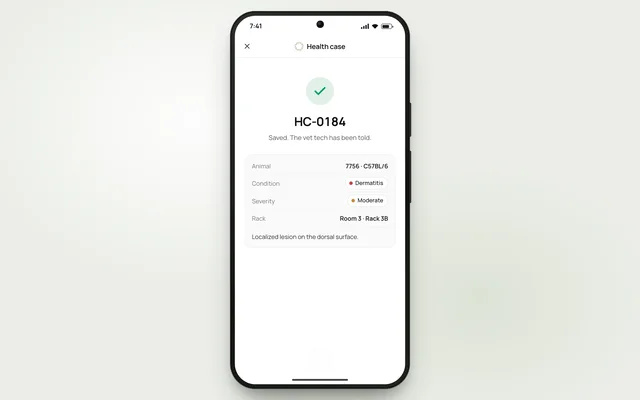
Priya Sood fills in the form after the morning check. Its record number, HC-0184, can go on the card.
Vet team told
Creating the record emails the vet team, or posts to their Slack or Google Chat channel.
Taken
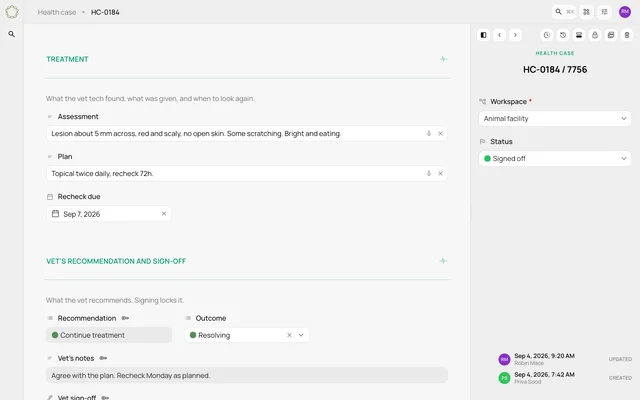
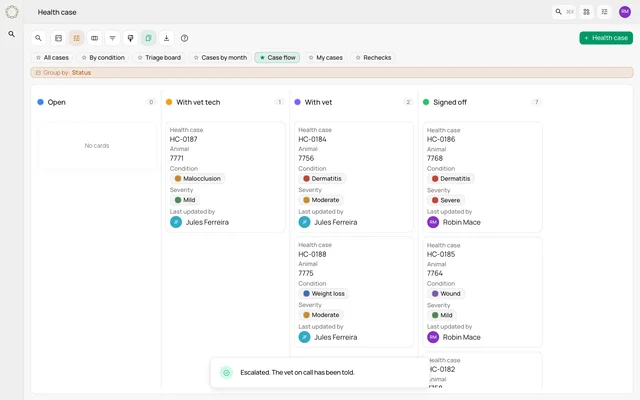
Jules Ferreira presses Take this report, and the vet team's section opens on the same record.
Lab told
Tell the lab emails the PI named on the record, Noor Adler. A morning list shows labs that haven't answered.
Facilities that phone first keep the phone: whoever answers opens the record during the call. Urgent and routine reports run as two workflows, because Streamcell has no if-then step. The report becomes the health case on the same record, so the vet team never types it twice.
08 / Sick animal reports
The research behind this guide
We read the public procedures of 20 research animal facilities in the US and Canada, mostly universities, in October 2026, and recorded how each one runs the job: who starts it, who receives it, what the form asks for and where the record ends up. Counts are facilities, not documents.