01 / Post-approval monitoring
What the procedures reveal
Three findings a compliance officer would stop on.
10of 13
pick protocols by pain or invasiveness category. 8 state how often, from twice a year to once in four years.
4of 13
let the PI or lab answer the findings before the committee sees them.
2of 13
publish their full checklist, though 5 send the PI a checklist or scope template before the visit.
02 / Post-approval monitoring
Where do PAM programs part ways?
One path from the notice to the IACUC, and the four points where the 13 programs split.
The PI or lab is told a review is coming
Step · 11 of 13
11 of 13
How does the review reach the lab?
Programs split · 6 ways
A booked lab visit
7 of 13Most common
Watching a procedure
2 of 13
A video meeting
1 of 13
Records and an interview
1 of 13
Rounds on a watch list
1 of 13
Twice-yearly facility visits
1 of 13
And if a review finds a welfare problem?
Programs split · 2 ways
Straight to the vet or the IACUC
8 of 13Most common
A noncompliance or incident report
2 of 13
Not stated · 3 of 13
Who sends the findings on?
Programs split · 4 ways
The IACUC office or committee
6 of 13Most common
PAM or compliance staff
5 of 13
A vet
1 of 13
An IACUC-appointed monitor
1 of 13
A written report or summary goes to the PI
Step · 10 of 13
10 of 13
Does the lab answer before the IACUC sees the findings?
Programs split · 2 ways
No lab step first: the IACUC or its chair has them
9 of 13Most common
Yes: the PI or lab answers first
4 of 13
The IACUC hears the findings
Step · 13 of 13
13 of 13
03 / Post-approval monitoring
How does a PAM review reach the lab?
The first fork, way by way: how the review reaches the lab.
A booked lab visit
The PI is told and a time is booked. Reviewers check the lab against the protocol, talk it through, then send a written report.
7 of 13Watching a procedure
A PAM team watches a planned procedure and sends a summary of refinements.
2 of 13A video meeting
A small committee meets the lab by video for about an hour, and the office sends a summary.
1 of 13Records and an interview
A subcommittee reads the records and interviews the PI by phone, email or in person.
1 of 13Rounds on a watch list
Vet techs check the animals on the IACUC's watch list every month.
1 of 13Twice-yearly facility visits
Committee members visit each facility twice a year with a site visit form.
1 of 13
On the visiting team, a separate count from who sends the findings on: staff or vets with no committee member required at 6 of 13, committee members at 7. 5 of 13 can put the work on hold, and 8 state that a welfare problem found on a visit goes straight to the vet or the IACUC. At 3, sick animal reports feed PAM.
04 / Post-approval monitoring
What does a PAM checklist check?
How many of 12 programs list each check.
PAM visit
Used by, out of 12 programs’ checklists
- Selected
- Scheduled
- Visit done
- With PI
- With IACUC
- Closed
Protocol and visit
- Protocol *Text3 of 12
- PI *User2 of 12
- Visit type *Dropdown
Routine · For cause · Follow-up · Requested by lab
for the workflow - Why selected *Dropdownfor the workflow
- Visit date *Date and time3 of 12
- Format *Dropdown
In the lab · Watch a procedure · Video call · Phone or email interview
for the workflow - Rooms visitedLink: Housing Room1 of 12
- Visiting team *User2 of 12
- Surgery on protocolCheckboxfor the workflow
Protocol and people
- Work matches protocol *Dropdown
Yes · No · Not observed · N/A
10 of 12 - Training documented *Dropdown
Yes · No · Not observed · N/A
7 of 12 - Everyone listed on protocol *Dropdown
Yes · No · Not observed · N/A
5 of 12 - Animal numbers tracked *Dropdown
Yes · No · Not observed · N/A
4 of 12
Anesthesia, surgery, post-op opens when the workflow reaches it
- Anesthesia as approved *Dropdown
Yes · No · Not observed · N/A
4 of 12 - Surgery as approved *Dropdown
Yes · No · Not observed · N/A
3 of 12 - Aseptic technique *Dropdown
Yes · No · Not observed · N/A
3 of 12 - Analgesia as approved *Dropdown
Yes · No · Not observed · N/A
3 of 12 - Post-op care documented *Dropdown
Yes · No · Not observed · N/A
5 of 12
Euthanasia, records, rooms
- Euthanasia as approved *Dropdown
Yes · No · Not observed · N/A
6 of 12 - Records available *Dropdown
Yes · No · Not observed · N/A
6 of 12 - Drugs and supplies in date *Dropdown
Yes · No · Not observed · N/A
3 of 12 - Lab safe and clean *Dropdown
Yes · No · Not observed · N/A
5 of 12 - Housing acceptable *Dropdown
Yes · No · Not observed · N/A
4 of 12
Findings opens when the workflow reaches it
- FindingsTable5 of 12
- Welfare concernCheckboxfor the workflow
- Work on holdCheckboxfor the workflow
- RecommendationsRich text3 of 12
- Response dueDatefor the workflow
PI response opens when the workflow reaches it
- PI response *Rich textfor the workflow
- Amendment submittedCheckboxfor the workflow
10 of 12 check that the work matches the approved protocol, 7 check training records and 6 euthanasia. The lists hold 90 different checks, and 58 appear at one program only, such as whether animals taken to a teaching lab are back in the vivarium within 12 hours.
05 / Post-approval monitoring
Find your starting point
Answer yes or no to find the programs that work like yours.
Question 1
Does someone from the IACUC side come into your lab or animal rooms for it?
See every question
- Does someone from the IACUC side come into your lab or animal rooms for it?
- Is it a routine round of every room or of a watch list, rather than a visit booked for one protocol?
- Is it a site visit of the whole facility by committee members, once or twice a year?
- Do they come to watch a procedure being done live?
- Is it a video meeting with your lab?
- A booked lab visit: You work like 7 of the 13, the most common way.
- Watching a procedure: You work like 2 of the 13.
- A video meeting: You work like 1 of the 13.
- Records and an interview: You work like 1 of the 13.
- Rounds on a watch list: You work like 1 of the 13. The watch list becomes a saved view.
- Twice-yearly facility visits: You work like 1 of the 13.
06 / Post-approval monitoring
What do the rules ask for?
Oversight and the power to suspend. None sets how often a protocol is visited or what a checklist holds.
- Animal Welfare Act regulations (9 CFR 2.31): the IACUC inspects every animal facility, including study areas, at least every six months, and can suspend work not done as approved, by a vote at a convened meeting.
- The Guide: continuing IACUC oversight after approval is required by federal rules and policy. IACUC, vet, animal care and compliance staff may all do PAM.
- In Canada, the CCAC: each institution sets its own PAM procedures and says who does what.
07 / Post-approval monitoring
How does Streamcell run it?
The default is the most common way: a booked visit and a report to the PI.
Selected
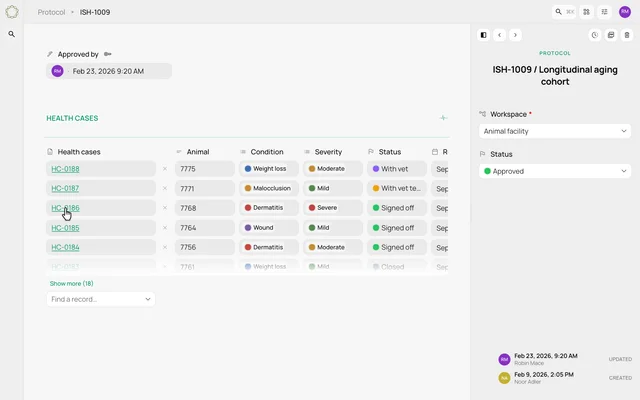
Noor Adler's protocol ISH-1009 is picked for its survival surgery. Schedule the visit emails her the date.
Visit
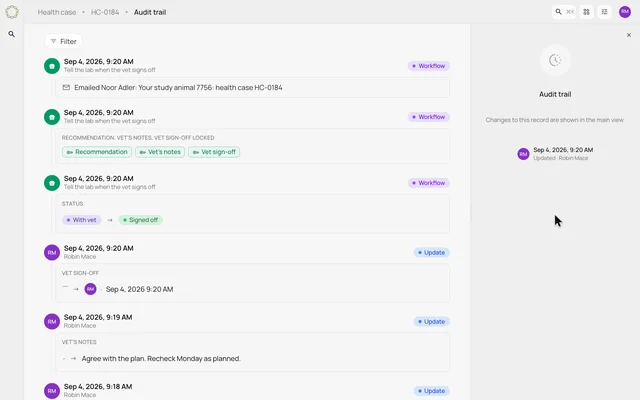
Robin Mace and an IACUC member visit and fill in the checklist. Jules Ferreira shows the post-op records for animal 7756, linked to its health case HC-0184.
With the PI
Send report to PI locks the findings, emails Noor and opens her response section. A daily check chases a late answer.
With the IACUC
Send to IACUC readies it for the next meeting. Close visit tells Noor and locks the record.
Ticking Welfare concern emails the vet and the IACUC chair at once. Your IACUC system stays where it is: the protocol number is typed in. PI-first and committee-first programs run as two workflows, because Streamcell has no if-then step.
08 / Post-approval monitoring
The research behind this guide
We read the public PAM procedures of 13 animal care programs in the US and Canada, mostly universities, in October 2026, and recorded who visits, how protocols are picked and whether the lab answers the findings before the IACUC sees them. Counts are programs, not documents.